Shopee · Seller Center
Turning campaign complexity into clearer decisions
Empowering high-volume sellers in Indonesia to turn Shopee’s campaign priorities into choices that fit their products and sales plans.
- Key result
- More successful seller participation, stronger campaign engagement, and less manual work for Business Development.
- Company
- Shopee
- My role
- Product Designer
- Timeline
- March–June 2023
- Team
- 1 Product Designer · 2 Product Managers · 3 Engineers · Business Development teams
- My Contribution
- I helped move the team from a quick ranking update toward a research-informed MVP. I compared ways to balance platform priorities with seller goals and designed the usability study and testing materials. I conducted sessions with Indonesian BD, then worked with engineering to validate the combined redesign through A/B testing.
Design snapshot
Move from Shopee’s campaign priorities to a session that fits your products and sales plan. Explore the flow, review the offer, and follow the nomination through submission.
BD was filling the gaps
I partnered with the local BD team on contextual interviews and observed how sellers chose campaigns. They repeatedly scrolled, compared options, and waited for BD recommendations before deciding where to start.
The list made campaigns look equally important. Sellers could see what was available, but had little help deciding what deserved their attention. The project presentation recorded BD spending 40% of its time helping sellers upload campaign products. Self-service was an operational problem as well as a usability problem.
I reframed the problem around the decision sellers were trying to make. A clearer starting point could help them engage with platform priorities; a way to narrow the options could help them judge whether those priorities suited their own plans.
Seller journey
Explore campaigns
Enter the marketing area.
Ready to exploreChoose a campaign
Creation-time order mixes eligible and ineligible options.
Confused about priorityChoose a session
Name search and recency sorting still leave many options to compare.
Excited, then frustratedNominate products
Review session details and edit products before final nomination.
Unable to confirmBalance speed with seller fit
The product team favored keeping the existing platform ranking: it was quicker to ship and carried less change. From the design side, I pushed for time to check whether that approach would resolve the difficulty sellers were actually having.
I helped turn that disagreement into a question we could test: how much guidance did the platform need to provide, and what did sellers still need to decide for themselves? The team’s MVP direction retained a shared structure while making room to address seller relevance.
The product decision
Keep delivery focused
Retain the existing ranking and familiar structure.
Risk: the choice can remain unclear.Improve seller relevance
Make goals, promotion type and timing part of the decision.
Risk: expand scope before validating the need.Shared priority + seller-controlled filters
The platform gives direction. Sellers decide what fits.
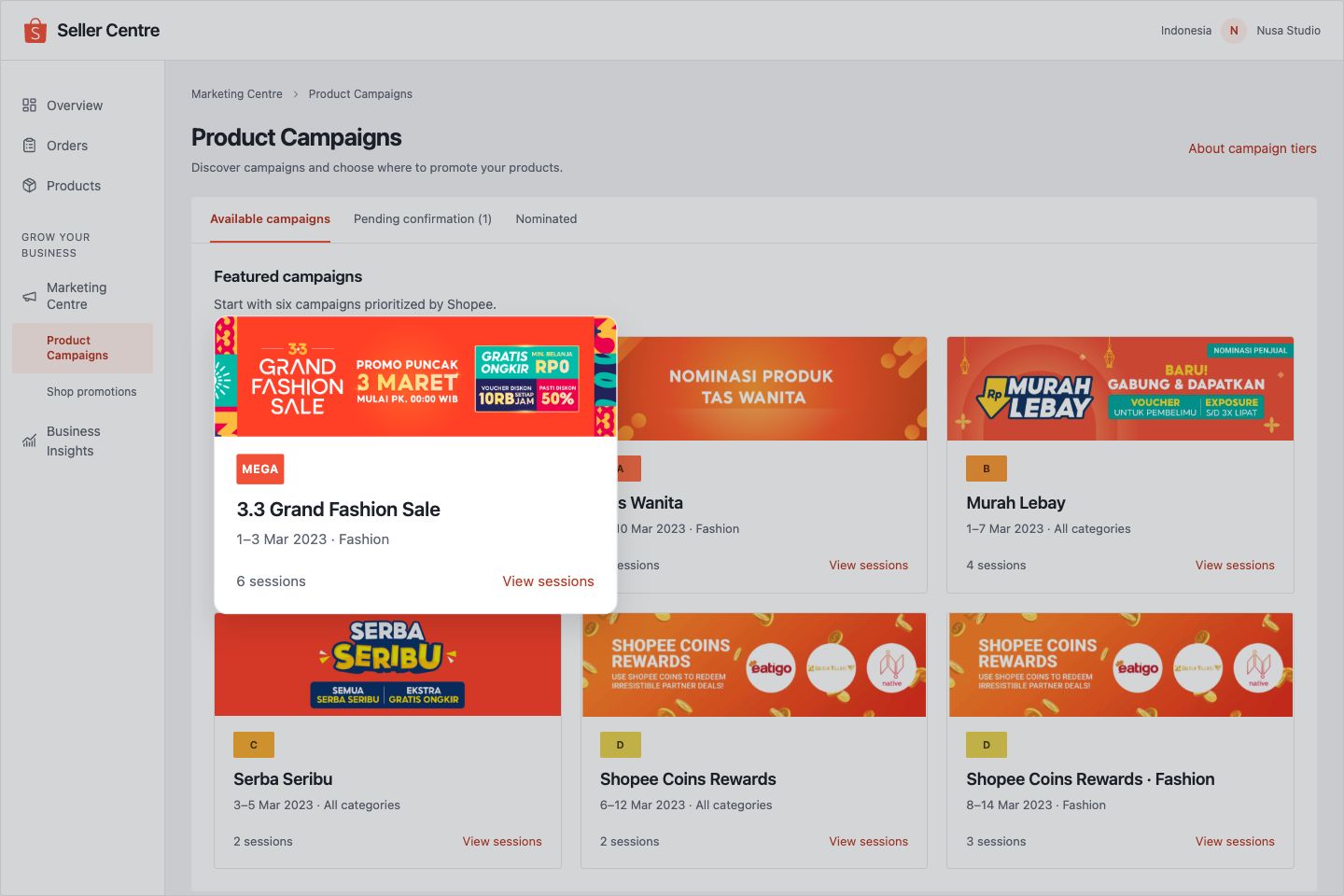
Platform-led priority
Value
A common ranking makes strategic campaigns easier to recognize and gives BD a consistent starting point for guidance. I explored ranking cues and a gallery highlighting six campaigns as ways to make that priority visible.
Tradeoff
A platform-wide order cannot describe what is most relevant to every seller. Experienced sellers still need to judge whether a campaign fits their promotion plans.
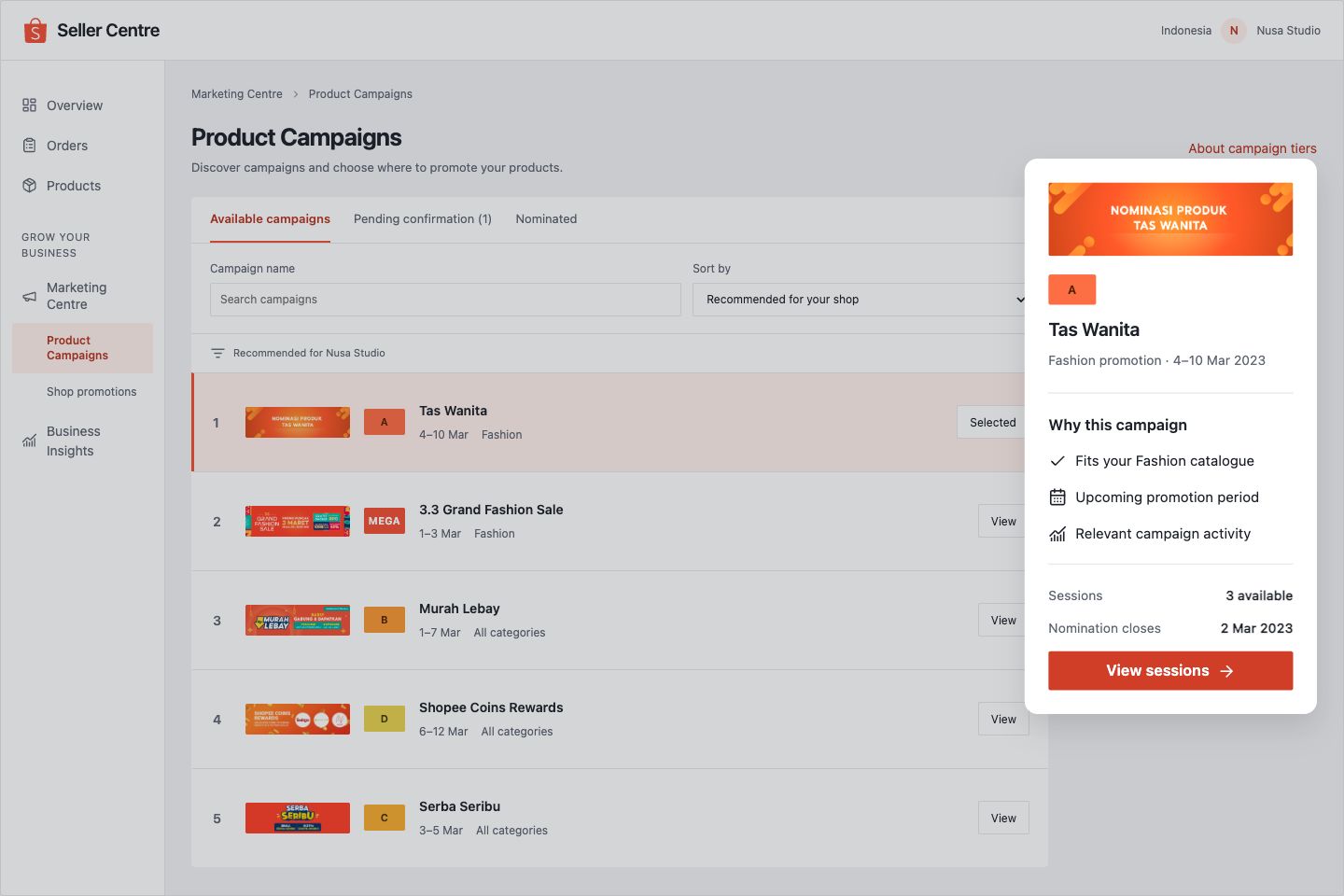
Seller-relevant ranking
Value
A personalized ranking direction could make the order more relevant to sellers’ growth objectives and promotion plans.
Tradeoff
The earlier exploration raised concerns about complexity and a less standardized experience. I needed to understand which seller preferences should be explicit controls, rather than assume that ordering alone would solve the problem.
The concepts included type-and-date filters, a top-six gallery and a more relevant ranked list. I compared them through usability, business needs and feasibility, then used seller testing to understand what ranking alone still left unresolved.
Ranking was only the start
I explored design directions and designed the full usability study. I prepared the testing materials and shared them with the Indonesian BD team, then worked with them to conduct sessions with 10 high-volume sellers.
The sessions showed that clearer ranking helped, but sellers still scrolled through many options before reaching a choice.
Turn feedback into design direction
I worked with the team to group the testing findings into themes. Together, we connected sellers’ feedback to three needs: relevant promotion types, campaign dates and clearer priorities.



Grouping usability-testing findings with the Shopee team.
What testing revealed
Promotion type
Sellers wanted to focus on promotions relevant to their products and plans.
Campaign dates
Timing mattered when comparing which sessions to join.
Clear priority
Sellers needed to recognize which campaigns deserved their attention.
Keep priority visible. Let sellers narrow the choice.
I translated these findings into a focused MVP: retain a recognizable campaign structure, make platform priority visible, and add filters for promotion type and date.
Put each goal at the right step
I kept platform priority at the campaign level and added seller-controlled filters at the session level. This gave each kind of decision a place in the same path: understand the platform’s focus, then find a session that fits.
Campaigns provide a starting point
I made campaign priority visible through the tier hierarchy and clearer ranking cues. Sellers could recognize which campaigns the platform emphasized before comparing the opportunities within them.
The tier guides attention. It does not decide whether a seller’s products or plans are a good fit for a particular session.
Sessions make the choice relevant
At the session level, I introduced filters for promotion type and date. Sellers who already had a plan could narrow the list around that plan before comparing the remaining options.
This retained a common campaign structure while giving sellers direct control over promotion type and timing. The tradeoff is deliberate: these filters support the decision at hand without trying to represent every seller objective in the ranking.
The decision spans both sides
Seller-facing filters also depend on how campaigns are maintained. Campaign managers define tiers and mechanic labels, and product sessions reference those labels so the seller-facing choices stay connected to operational configuration.
The campaign-management design makes this relationship explicit: campaign priority belongs to the campaign, while the promotion label belongs to the sessions sellers can select. That provides a shared structure for platform priorities and seller choice, rather than requiring the seller-facing list to carry every operational decision.
My role connected different kinds of input. Local BD brought the context behind sellers’ choices and helped facilitate testing. I translated that evidence into the ranking and filtering decisions. Once the interaction model stabilized, I worked with engineering on A/B validation of the combined experience.
In the related design-system work, I also partnered with a visual designer and developers to standardize B2B patterns for Seller Centre’s adaptation across 11 markets. A shared interaction structure could stay consistent while labels and local context changed.
Participation rose as support work fell
The original presentation reports improvement across three parts of the experience: more successful seller participation, higher campaign engagement and less manual support work. Together, they connect the design to both seller action and operational capacity.
45%86%
41 percentage points higher
5%9.5%
90% relative lift in CTR
70% less
4,480 hours / year
Reported annual saving
Seller participation success increased from 45% to 86%, a gain of 41 percentage points. Campaign CTR rose from 5% to 9.5%, a 90% relative increase. The presentation also records 70% less manual work and 4,480 hours saved per year.
The business value was a more scalable path into campaigns: sellers could make more of the decision within Seller Centre, while BD spent less effort on manual participation support. Improved campaign participation creates opportunities for exposure and sales; the available results do not quantify revenue or profit growth.
The result reinforces the product decision: give the platform and seller different responsibilities within one flow. Platform priority provides direction; sellers bring promotion preferences and timing. I would next track time to an eligible nomination and downstream campaign sales to understand how this change translates into seller returns.
Carry the choice into action
The next design direction extends the same decision model to product nomination and campaign maintenance.
Make the commitment visible
Finding a relevant session is only useful if the seller can judge the offer they are about to submit. The proposed nomination flow brings product eligibility, campaign price, reserved stock and purchase limits into a connected sequence before confirmation.
Validation gives the seller a place to correct the offer, while the submitted state distinguishes a nomination under review from an approved place in the campaign.
Make a live change understandable
The campaign-management design already calls for confirmation when a published label changes. The updated proposal makes that confirmation more informative by showing the old wording, new wording and linked sessions before the operator proceeds.
This carries the original tradeoff into maintenance: operations can keep campaign language useful, while understanding what will change in the seller’s filters.